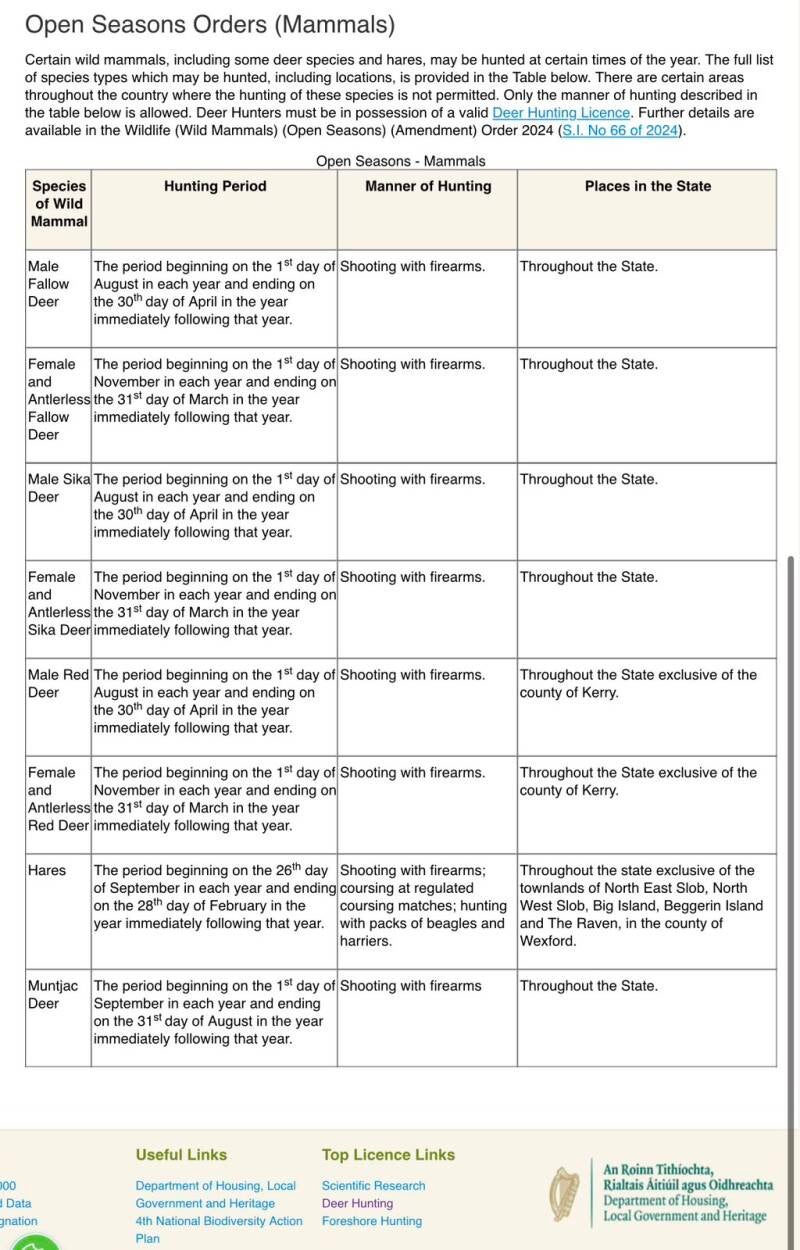
Open season for 2026/27 seasons
Note :- hunting is permitted outside of the open season with a valid season 42 permit for after daylight it must be strictly marked with either or both for lamp and use of thermal imaging
Red Deer
(Cervus elaphus scoticus, Lönnberg, 1906)
Full classification: Phylum Chordata, Sub-phylum Verbrata, Class Mammalia, Oder Artiodactyla, Family Cervidae, Sub-family Cervinae, Genus Cervus, Species Cervus elaphus scoticus.
Origin & History:
The red deer is Ireland’s largest land mammal and is the only species of deer that is considered native to Ireland. They earned their ‘native’ or indigenous status, as they are believed to have survived our last ice age or are the closest living population to the post-glacial native Irish Red deer.
Although Red deer can be found in most counties the only herd that are believed to be native or indigenous are those found in Killarney. In the 1960’s the Red deer in Killarney numbered 100 animals or less, these animals were brought back from the brink of extinction by the efforts and work of the Kerry Branch of the Irish Deer Society. Now there are approximately 600 – 700 native Red Deer in the Killarney Valley area of Co. Kerry. A small herd of the Killarney Red deer has been translocated to Innismhicilean island off the Kerry coast. The reasons for this was to preserve and conserve their genetic pureness. Two other captive native herds of these animals are held in Doneraile, Co. Cork and in Co. Tyrone. Thus, theoretically, these animals could be used to restock the Killarney Valley if hybridisation or serious disease occurs.
Adult Size:
Adult males are known as stags, weigh up to 220Kg, Females as hinds, weighing up to 110Kg, Offsprings are calves, which weigh 6-9Kg. have a spotted coat until the age of about 2 months old.
Description:
Summer coat is a deep-reddish-brown colour, spots can occur along spine. The underbelly is cream, as is inner thighs and rump. In winter the coat is shaggy, thick (for insulation against the cold and rain) dark brown-grey in colour, with light patches on the undersides and rump. The caudal patch extends higher over the rump than in most other deer, being a cream colour. The tail has a dark stripe that extends upward along the spine. Age and the condition of the individual animal can seriously affect this general appearance. The metatarsal gland, found on the hind legs is a creamy colour.
Food & Feeding:
Red deer are primarily grazers, but other food sources if available are taken advantage of. These include heather, dwarf shrubs and rough grasses such as Molina sp. Found on the uplands. Heather plays an important food source to uphill animals during the winter months, especially if there is snow-covered ground. If the weather is harsh enough then the deer may be forced from the upland to migrate to nearby farmland to feed upon farm crops, this occurs generally at night.
The Rut:
The rut occurs during the month of October and may last up to 6 weeks. The two sexes are segregated throughout the year apart from the rut. The males congregate to form bachelor groups, these vary in the number of individuals present. They begin to become intolerant of each other from August onwards; this is due to the now increasing levels of the male hormone testosterone. The increasing levels of this hormone stimulates the increase in neck size (mane) and testicle size, as well as the cleaning of the new antlers of the velvet covering, the general thickness of such a mane depends on the condition and age of the stag. The photoperiod or the changing lengths of light and darkness determine the level of testosterone. The hinds begin to congregate in their traditional rutting areas. Sexually mature stags (5-11yrs) take ‘possession’ of hind harems, which they will defend from other stags and herd in any hinds that wander close. Up to 20% of a mature stag’s body weight may be lost during this rutting period, as they tend not to consume much. The rut peaks generally in mid-October, where fighting can escalate, resulting in serious injury and possible death. Many Stags can be sufficiently weakened from the rut, especially older animals and followed by a harsh winter, they may not survive.
Breeding:
Calves (singles) are born during the period of late May until early-mid June after a gestation of 229 days. They are born with a spotty coat, which remains with them up until the age of about 2 months. This dappled coat camouflages the calf until its mother returns to suckle it. Suckling occurs on average every 2-3 hours during the first few days, after which the time lapse is greater between feeds. The mother wil return to the area where she left her calf, and call to it with a short bark to locate it. Interestingly enough, that apart from the rutting and calving calls, both sexes are generally silent throughout the rest of the year, unless emitting an alarm call.
Antlers:
Antlers are cast between Mid-March and April and regrown every year, so they are in their prime for the rut. Older Stags tend to cast earlier than younger ones. The antlers form in Red deer is of many branches of multi-points, the number of which can vary considerably with age, condition of the stag. These antlers are used in fights during the rut. Red deer fight characteristically by pushing and shoving the opponent by the antlers, untilone is pushed backwards, at which point the winner will chase off the loser.
Damage/Economic factors:
They can cause considerable damage in young broadleaf woodland, eating the leaders and side shoots and also in agricultural crops. Red deer are extensively farmed for their venison.
Japanese Sika
(Cervus Nippon Nippon, Temminck 1838)
Full Classification: Phylum Chordata, Sub-phylum Vertebrata, Class Mammalia, Oder Artiodactyla, Family Cervidae, Sub-family Cervinae, Genus Cervus, Species Cervus Nippon Nippon.
Origin & History:
Sika are indigenous to eastern Asia, the Japanese islands, Taiwan and the mainland from Manchuria to Vietnam. The word ‘Sika’ is Japanese for deer. In 1860 the seventh Lord Powerscourt introduced one stag and three hinds to his estate near Enniskerry in Co. Wicklow.
In 1865, Lord Powerscourt translocated one stag and two hinds to Muckross estate in Kerry where they flourished.
Distribution:
Sika have spread to most of the counties of south Leinster including Dublin, Kildare, Carlow and Kilkenny – spreading relatively quickly where there are areas of interconnecting forestry. However there are reports of Sika appearing in Laois, Galway, Mayo, Tipperary, unlikely to have occurred by natural expansion, suggesting human assistance at some level.
Adult Size:
The male known as a stag, weighs between 50-60Kg; females referred to as hinds weigh between 30-40Kg. the Adult male has a shoulder height of 7- to 95cm, while the hind is somewhat smaller, 50 to 90cm at shoulder height. Hinds give birth to generally a single spotted offspring (calf- approximately 2Kg) from May to early June after a gestation period of 7 ½ months; twins are a rare occurrence.
Description:
The summer coat is a light-reddish brown colour with white spots. In contrast the winter coat is dark grey with the white spots virtually disappearing. A distinctive feature is the black-bordered white rump patch, present year round, when alarmed, this patch of hair will flair to two or three times its normal size. This is an alarm mechanism to alert other deer in the group to a potential threat. There is a distinctive dorsal black strip, which is prominent in both winter and summer coats.
The Metatarsal gland is white as opposed to cream coloured in Red deer. The tail is medium-long, but shorter than fallow deer. The Sika stag has a distinctive ‘V’ shape to the forehead, formed by lighter coloured hair on the forehead.
Food & Feeding:
Sika deer are predominantly grazers, feeding upon grasses, broad leaf buds, heather, and coniferous tree shoots. They can readily adapt to sparse conditions found in conifer plantations as they have a preference for acidic soil habitats.
The Rut:
The rut or breeding season begins at the end of September and usually runs until November. Stags and hinds remain segregated for most of the year, only coming together during the rut. Wallowing by the stag is done , here they tend to use their musk glands as well as urinate over themselves, thus creating a distinctive ‘rutting’ smell. During the rutting period the stags have a enlarged shaggy neck (common in most deer species).
Sparring occurs in early September when stags reach their prime conditions. Mature stags defend their territories ruthlessly (unlike reds which hold a harem), only towards the end of the rut, when the stag is exhausted will you see younger animals taking advantage to mate an unguarded hind.
Stags give a high pitched whistle during the rut; use of this ‘whistle’ may be used to attract hinds, mark out territories and warn off potential rivals. When alarmed both sexes give out a short high pitched bark.
Antlers:
The typical mature Sika stag has an eight point head, four points on either antler. Brow tines are always less than 90 degrees to the main beam. Whereas feeding has an important part to play in the size of antlers, genetics are important.
The heads of Wicklow Sika tend to be stronger and heavier than Sika elsewhere, perhaps reflecting presence of red deer genes.
Wicklow heads develop from six to eight points at an earlier age than, for example, the Sika of Co. Kerry, where a six point head is regarded as the norm.
Antlers are cast at the end of March.
Damage/Economic factors:
In areas where there is little available feeding, particularly in the winter and the spring, they are responsible for severe browsing damage to young trees and for bark stripping in semi-mature plantations.
Bole scoring, ripping off of bark with antlers, a common trait of Sika deer in the UK, is relatively rare in Ireland but is does occur. The Sika rut is the same as that of the Red deer, from the end of September to the beginning of November. Stags can be very aggressive, chasing and fighting other stags and thrashing vegetation.
European Fallow Deer
(Dama dama dama, Linnaeus, 1758)
Full Classification:
Phylum Chodata, Sub-phylum Vertebrata, Class Mammalia, Oder Artiodactyla, Family Cervidae, Sub-family Cervinae, Genus Dama, Species Dama dama dama.
Origin and History:
There are two members of this genus, the European Fallow deer and the Mesopotamian or Persian form. The Mesopotamian/Persian form is an endangered subspecies, which is only found in the wild in Israel and in a few isolated areas of Iran. The European Fallow is the most common species within the deer parks around the world, as they have several coat colour varieties making them extremely pleasing to the eye and the palmate antler form. Fallow deer (Dama dama) are not native to Ireland, but are the most widespread of our three main deer species. They are thought to have been introduced by the Normans to the ‘Royal Deer Forest’ of Glencree, Co. Wicklow in 1244. They were then spread over the centuries to numerous deer parks throughout the country. The major populations of Fallow deer are in Laois/Offaly, Tipperary/Waterford, Clare, Galway, Wicklow, Monaghan/Louth/Armagh, Fermanagh, Down, Roscommon and Sligo/Leitrim. However, in each county, the populations are often distinct, with little if any mixing between them. For example, there are a number of distinct areas with Fallow deer in Co. Galway, including Portumna, Ballygar and Mountbellew.
The Phoenix Park in Dublin is the largest enclosed park within Europe, with an area of 709 hectares. Originally it was created as a deer park in 1662, with fluctuating Fallow deer numbers throughout its history, there are now approximately 450 head. This herd is/has been intensively studied and is part of a long-term research project conducted by the Mammal Research Group (MRG of the Zoology Department, University College Dublin.
Adult Size:
The males are known as bucks, and weigh on average between 85-110Kg; females are does, with weights averaging 45Kg, they give birth to a single offspring (fawn) in June which weighs 3-5Kg. A typical height at the shoulder for a buck is 90cm, while a doe is about 80cm.
Description:
There are several varieties of coat colours in Fallow deer, the commonest being: black, brown, menil, common and white. All coats/pelages are best seen in the summer months, where all colours are vibrant and clearly distinguished. During the winter months the animals grow a thicker shaggy coat for insulation and are very dull. The bucks are characterized with distinctive palmate antlers, prominent Adam’s apple and penile sheath (brush). These deer have the longest tail of the three main Irish species which makes it a very distinguishing characteristic.
Food & Feeding:
Fallow deer prefer deciduous and mixed woodland habitats. They are classified as grazers or non-selective bulk feeders, although they will browse on trees and shrubs. They will also supplement their diet with acorns, other fruits, nuts and fungi when available. The species has become almost nocturnal in their grazing habits in areas of high disturbance, however in their preferred habitat of mixed pole-stage and semi-mature woodland, there are usually enough secluded places to graze undisturbed and a good understory of cover for lying.
The Rut:
During the rut, bucks make a distinct repetitive grunting noise, which sounds like a belch, while on the rutting stand. For the rest of the year they are generally silent. Around the stand, the ground is often torn up – bucks scrape the ground with their feet and antlers and thrash the branches of nearby trees, but they seldom wallow. During the rut, the neck swells and the end of the penis sheath and the flanks become stained. They urinate over themselves and scent-mark surrounding vegetation from their suborbital glands. The same areas tend to be used for rutting by Fallow deer year after year. Unlike other species of deer, Fallow bucks can rarely be called off a stand. Rutting activity consists of the continual parading of the stand area with occasional periods of grunting.
Breeding:
Fawns are generally born between June until early July, later than Red deer and Sika. They are born with a dappled coat that helps camouflage them in the undergrowth, where they will stay for the first week or so of life, with the mother coming back to feed the calf every few hours.
Antler:
Bucks display palmate antlers, unlike antlers of Red deer or Sika. The large flat palmate antler is fringed with points known as spellers, which are numerous. These antlers are cast and regrown each year, where they are used as combat weapons and for display during the rut. Antlers are fully formed by the end of August; the velvet dries and is shed within a week or so.
Damage/Economic factors:
They can cause considerable damage in young broadleaf woodland, eating the leaders and side shoots, and also in agricultural crops. Fallow deer are also farmed for their venison.